
Muhlenberg Deed Records by Type
The County Clerk in Muhlenberg County records deeds along with the documents that can burden or refine an ownership interest. A grantor gives up an interest. A grantee receives it. Beyond the names, a deed may carry the consideration, legal description, prior source of title, preparer and return address, signatures, acknowledgment, and the Clerk's certification, so read the wording rather than trusting the label on the first page.
| Deed Type | What It Does | Common Use |
|---|---|---|
| Warranty deed | Conveys the stated interest with written covenants | Ordinary sale |
| Quitclaim deed | Conveys whatever interest the grantor holds | Family or corrective transfer |
| Executor or trustee deed | Transfers through a fiduciary under stated authority | Estate or trust |
| Commissioner's deed | Records a judicially authorized conveyance | Court sale or partition |
| Correction deed | Corrects identified terms in a prior filing | Name or description fix |
A mortgage secures a debt. A lien asserts a claim. An easement grants someone a defined use of the land, and each of these filings can attach to the same tract as the deed. Pull the release or modification along with the original instrument, because no record should be read without its later history.
Search Muhlenberg eCCLIX Fields
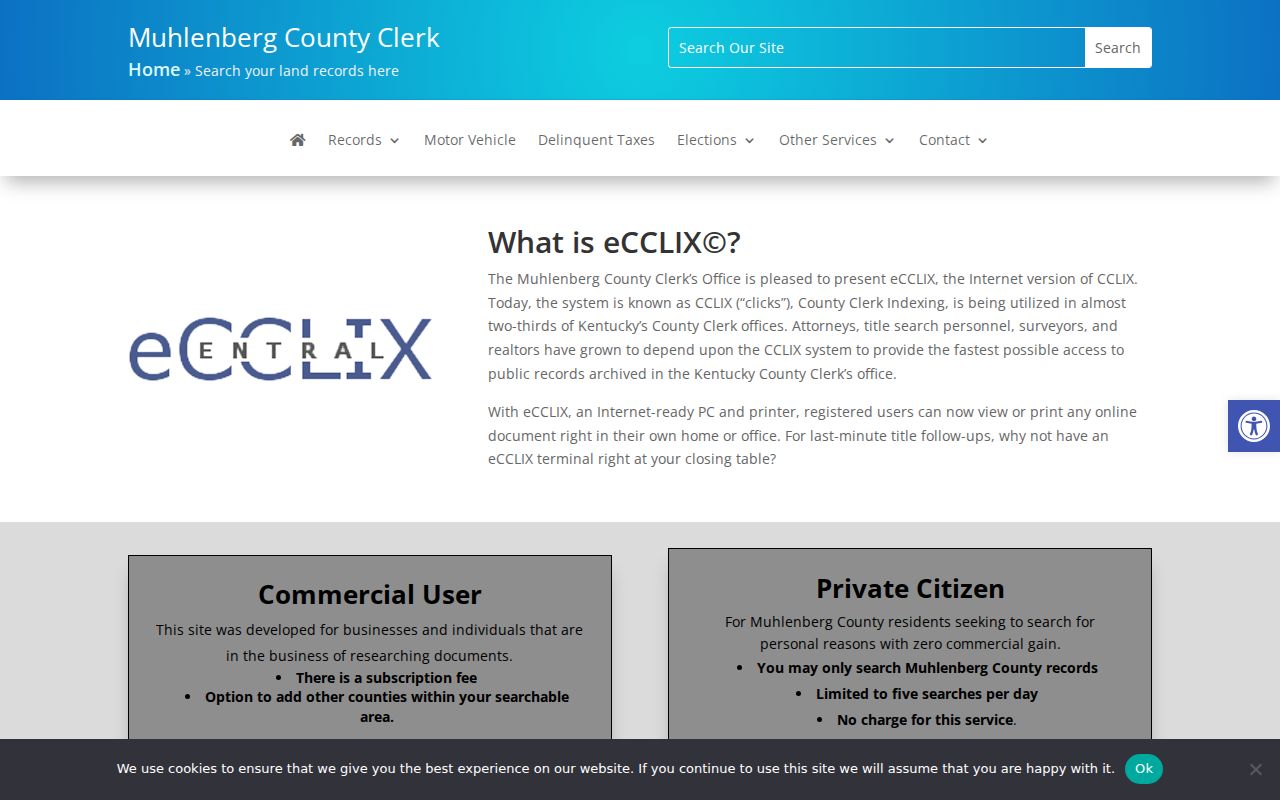
The Clerk points the public to eCCLIX. Citizen searching there is free, limited to Muhlenberg County, and capped at five searches per day. Image display and printing require registered access. Spend the queries with care. A precise PVA owner name is the best starting point, since the vendor states that parcel and bill numbers are not direct deed-index keys. The clerk's search page remains the county's official route into that system.
| Index field | Use | Save |
|---|---|---|
| Grantor | Party that conveyed | Exact name |
| Grantee | Party that received | Role and spelling |
| Book/type/page | Known citation | Complete reference |
| Instrument number | Known filing | Number and type |
| Recording date | Narrow a time span | Date range |
The Clerk's recorded instruments span deeds, mortgages, releases, plats, easements, liens, and lis pendens. A document-type filter may appear in the portal. The vendor sets the live field list. The county's own page simply hands searchers off to that system, and a visit shows which filters are actually offered.
Muhlenberg Image Cutoffs Matter
Online image coverage starts in April 2002 for deeds and September 2006 for mortgages. Those dates only mark image coverage. Recording in Muhlenberg County reaches back much further. The Clerk can still pull an older index entry, book, image, or certified copy. The KDLA inventory lists Muhlenberg deed microfilm from 1798 through 2016. Old assessment books can place an owner in time. FamilySearch tax reels help too, but neither one replaces the deed itself. Old descriptions read oddly. They may cite roads, watercourses, adjacent owners, or coal interests rather than any street address. Or they may rely on survey calls. Myth check: the online image cutoff is not the start of Muhlenberg County deed records.
Check Muhlenberg Recorded Interests
A careful deed search looks at the filings surrounding the transfer. Mortgages show secured debt. Releases show its recorded discharge. Easements can grant access, utility, or drainage rights, while plats organize lots, blocks, streets, dedications, and restrictions. A lis pendens can tie the land records to a pending court case. Mineral property demands extra care in Muhlenberg County. A surface-owner result never settles coal or mineral rights. Search mineral leases, reservations, releases, easements, company names, and old plats, and when a court filing affects title, note the case number and ask the Circuit Clerk for the full file.
Walk Muhlenberg's Deed Chain
A chain of title is the ordered sequence of transfers for one Muhlenberg County tract. Start with the newest confirmed deed. Read its source-of-title clause. Next, search the current grantor as an earlier grantee, keeping the tract fixed at every step with a book and page, instrument number, lot and block, acreage, or metes-and-bounds description.
- Find the current acquisition deed with the title name as grantee.
- Save grantor, date, citation, and legal description.
- Search that grantor as an earlier grantee and match the land.
- Continue through Clerk books or microfilm when images end.
- Grantor
- The party transferring an interest.
- Grantee
- The party receiving an interest.
- Chain of title
- The linked sequence for the same land.
- Book/page and instrument number
- Recording citations used to locate a filing.
Order a Muhlenberg Deed Copy
Online images work when coverage and account access allow it. Otherwise, call the County Clerk. The Greenville main office and the Central City branch both handle deed requests, so give the parties, the rough date, the document type, and the recording reference. Ask about plain versus certified copies. Confirm the current charge too. The Clerk also takes focused open-records requests by hand, mail, fax, or email, with a written determination due within five working days under its policy. Posted noncommercial fees run $0.50 per paper copy and $5 for recordings, discs, or tapes. Statutory fees apply first, and prepayment may be required.
Recorded is not guaranteed. The index shows filed instruments. It does not identify every unrecorded interest or replace a title opinion.
Monitor Muhlenberg Deed Filings
The Clerk runs a free deed and mortgage notice service called DOC ALERT. Enrollment takes a name and email. A filing under an enrolled person or business triggers a prompt to review. It blocks nothing. It neither removes nor validates a document. Match the notice to the parcel and image, keep the recording reference, and contact the Clerk if a filing looks wrong.
Muhlenberg Probate Chain Breaks
A tidy buyer-and-seller sequence breaks in these cases. An owner dies, a court orders a sale, or a fiduciary signs the deed. Then the names change. Search the decedent, the estate, the executor or administrator, heirs, and trustees. Also search any commissioner named in the instrument. A will, probate order, affidavit, executor deed, or commissioner's deed may explain the break. It shows why the next grantee departs from the expected name. CourtNet offers case numbers and party lists. CourtNet is only case information. The full file sits with the Circuit Clerk in Greenville. The filed order belongs beside the recorded deed. A death certificate may support identity and timing, but it never conveys real estate.
Verify Muhlenberg Deed Copies
Look closely at any deed copy before relying on it. A purchase, estate question, mineral claim, or boundary dispute raises the stakes. Check that the image runs start to finish. Every page, exhibit, stamp, and acknowledgment should appear. Note the instrument type and date. Record the book and page, instrument number, grantor, grantee, and return address. Preserve the source-of-title clause and the full legal description.
A portal image suits everyday research. A certified copy is the Clerk's official reproduction. Use it when certification matters. Neither one is a title opinion. If the chain shows conflicting descriptions, unreleased claims, or uncertain boundaries, bring in an attorney, title examiner, or licensed surveyor.
Names need their own pass. Search initials, spelling variants, married and former names, and fiduciary terms. An LLC should be searched exactly as deeded, then checked in the Kentucky Secretary of State entity database for status and filing names. A registered agent is not always the landowner. Trust property may sit under a trustee, a trust name, or both. An estate can appear under the decedent and the personal representative.
Keep the legal description consistent too. A subdivision parcel often uses lot and block with a plat citation. Rural land usually turns to metes and bounds, tracing lines through direction, distance, and monuments. Older coal or mineral instruments may split surface rights from mineral interests. Surface and mineral are separate estates. Do not merge them just because the street or owner name matches.
The web portal is not the only route. The Greenville Clerk office sits at 100 S Main Street, and the Central City branch is at 214 N 1st Street. The Clerk also accepts focused open-records requests by mail, fax, email, or hand delivery. Historic work can continue through KDLA reference service, FamilySearch catalog access, Thistle Cottage Museum and Archives, and local newspaper collections. Bring each archive lead back to a recorded book, page, image, or court order before treating it as title evidence.
Recording fees vary by document type. The Clerk's published list covers deeds, mortgages, easements, liens, plats, releases, wills, and other instruments, with added-page charges where they apply. These are filing charges, not a universal copy price. Ask the exact cost of a copy or certification. Confirm the live fee schedule before trusting any posted amount.
Historic tax books give a useful name-and-date cross-check. KDLA identifies intermittent Muhlenberg assessment runs from the county's early years through the twentieth century, and FamilySearch supplies reel details. A tax entry can tie a person to land and a value in one year. It cannot establish the interest conveyed. Use it to narrow the deed index, estate file, or land-entry search.
Original land research reaches beyond county deeds. The Kentucky Secretary of State Land Office name search accepts surname, given name, role, county, and watercourse or location. A patent or land entry starts a historic trail. It is not current title. Carry the result forward through Muhlenberg deed books.
Newspaper notices and genealogy abstracts can surface alternate spellings, commissioner sales, estates, subdivision names, or company interests. Treat them as leads. Verify each claim against the Clerk image, certified copy, probate order, or court file. Before closing the search, reconcile the newest deed with the PVA parcel, since a recent filing may precede the next assessment update.
Log the misses too. A search log preserves spelling variants, roles, dates, and record ranges already checked. That saves scarce citizen queries. It also makes a Clerk request far more precise.