
Build a Greenville Property Records Search
Greenville property records are kept by Muhlenberg County, not by any Greenville recorder or assessor. The starting point is the PVA/qPublic search. Its ownership and assessment fields open the trail. For a recorded title check, pair that parcel data with the latest deed on file with the County Clerk.
- Search the street address, then try the owner or county parcel/map identifier.
- Carry the exact owner or entity name into eCCLIX and inspect the newest deed and source-of-title reference.
- Check the Sheriff source for the tax bill and payment status.
- Compare the GIS parcel with any deed calls, plat, replat, easement, or survey.
- Ask Greenville City Hall for permit, zoning, variance, code, street, or annexation files.
A Greenville mailing address does not always mean the parcel sits inside the city. Rural routes around Muhlenberg County often carry a Greenville mailing line. The situs can still sit in unincorporated land. Treat the parcel number as the anchor and let it decide the jurisdiction. The full county property search walkthrough covers address and owner variants.
Match Greenville Property Records to Their Custodian
The PVA and the County Clerk both sit at 100 S Main Street. The Sheriff uses that same address. The Judicial Building is at 136 S Main. Assessment and parcel data belong to the PVA. Recorded instruments go to the Clerk. The Sheriff bills current taxes, and the Judicial Building holds court and probate files. City Hall at 118 Court Street keeps city-created records like zoning and permits. The counters are convenient neighbors, but no office can certify another office's work.
Muhlenberg County Record Counters
PVA for owner, value, and parcel; Clerk for deeds and plats; Sheriff for taxes; Circuit Clerk for court and probate.
Greenville Property Records Around the County Seat
Several custodians hold Greenville property records, and most sit within easy reach downtown. The PVA comes first. There you get the owner of record, the assessed value, and the property location. The same visit yields the parcel number. That parcel number opens the door at the Clerk. Request the deed, plat, easement, restriction, mortgage, or release that matches it. The Judicial Building holds probate, foreclosure, partition, and quiet-title material. City Hall, meanwhile, keeps the local land-use file for the parcel.
| Question | Greenville counter | Record to request |
|---|---|---|
| Who and what value | PVA, 100 S Main | Ownership, ASV, situs, map/account |
| How title changed | County Clerk, 100 S Main | Latest deed, source deed, plat, easement |
| Tax status | Sheriff, 100 S Main | Current bill and payment status |
| Probate or title suit | Judicial Building, 136 S Main | Local case file after CourtNet lead |
| City land use | City Hall, 118 Court | Permit, zoning, variance, annexation |
Working near the county seat saves steps, not effort. Each office keeps its own system. A tax-roll entry at one counter is not the same as a deed at another. Label every copy with its custodian and the date you retrieved it.
At the Clerk counter, request the most recent deed for the parcel. Also ask for the prior source-of-title instrument, any subdivision plat or replat, easements, restrictions, mortgages with releases, and any lis pendens on file. At the court counter, CourtNet party and case clues help you pull the actual file. Pull the probate, foreclosure, partition, or quiet-title file itself. A courthouse-area address puts several record families within walking distance. The request itself still has to name the right record family and date range.
Request City Files for Greenville Property Records
The city administration page lists City Hall contact details. It also identifies the City Building. Greenville's contact form asks for a name, email, phone number, and a message. Its real-estate page offers Street Department context rather than a searchable permit or zoning result. The city publishes no permit-number index, inspection table, zoning database, or fee schedule online.
| Available city input | Best request wording | Limit |
|---|---|---|
| General contact message | Give address, parcel ID, file type, and date range | Not a permit search result |
| Open-records route | Ask for permit, zoning, variance, inspection, or annexation files | Custody may require referral |
| Street Department context | Ask about a dedication or city street record | Not title or boundary proof |
Start by asking whether the city, a joint planning body, or another custodian holds the file. A city response can document use or enforcement history. It cannot show who owns the land. The Greenville administration page provides the city contact route shown here.
Greenville keeps permit files at City Hall. No searchable online permit database exists for city property records, so requests go through the office itself.
Districts and Lots in Greenville Property Records
Greenville publishes no complete online roster of subdivisions or district parcels. That gap does not leave you stuck. A plat reference, a former owner, a developer, or an old street form can still surface a lot's history in Greenville property records, and any match should be verified against the county deed records before you rely on it.
| District or search lens | Time context | Record trail |
|---|---|---|
| South Cherry Street Historic District | Historic district context | District source, deeds, plats, directories, newspapers |
| Thistle Cottage area | Building dates to 1912 | Library history as lead, then PVA and Clerk proof |
| Downtown and courthouse blocks | Older city lots | Lot/block and metes-and-bounds searches |
| Industrial or coal-company parcels | Company-land context | Company grantor/grantee, easement, restriction, replat |
Older lots reward creative searching. Try the street variant. Try the adjacent owner, the former owner, and the developer or company name. When a modern PVA description lists acreage but the deed says lot, suspect a replat, vacation, or later split. Then hunt for the recorded plat that settled it.
Historic Greenville deeds often skip the 911 address entirely. Instead they rely on lot and block language or metes and bounds. Preserve the legal description exactly, down to calls for roads, adjoining owners, alleys, and monuments. For a downtown or South Cherry parcel with shared access, search recorded road dedications. Search the restrictions and easements too. The plat and survey evidence outweigh any map outline on a screen.
Thistle Cottage Opens Historic Greenville Property Records
Library history offers a rich case in how one building accumulates property records across institutions. Thistle Cottage is a Spanish Mission Revival structure built in 1912. Its builder was William Graham Duncan, tied to Duncan Coal Company. The house stands in the South Cherry Street Historic District. Greenville received it as a donation in 1986. It opened as a museum three years later. The building passed from city to library ownership in late 2013. It now serves as an archive and genealogy resource, with its annex relocated in 2018. A deed search alone would miss half of that chain.
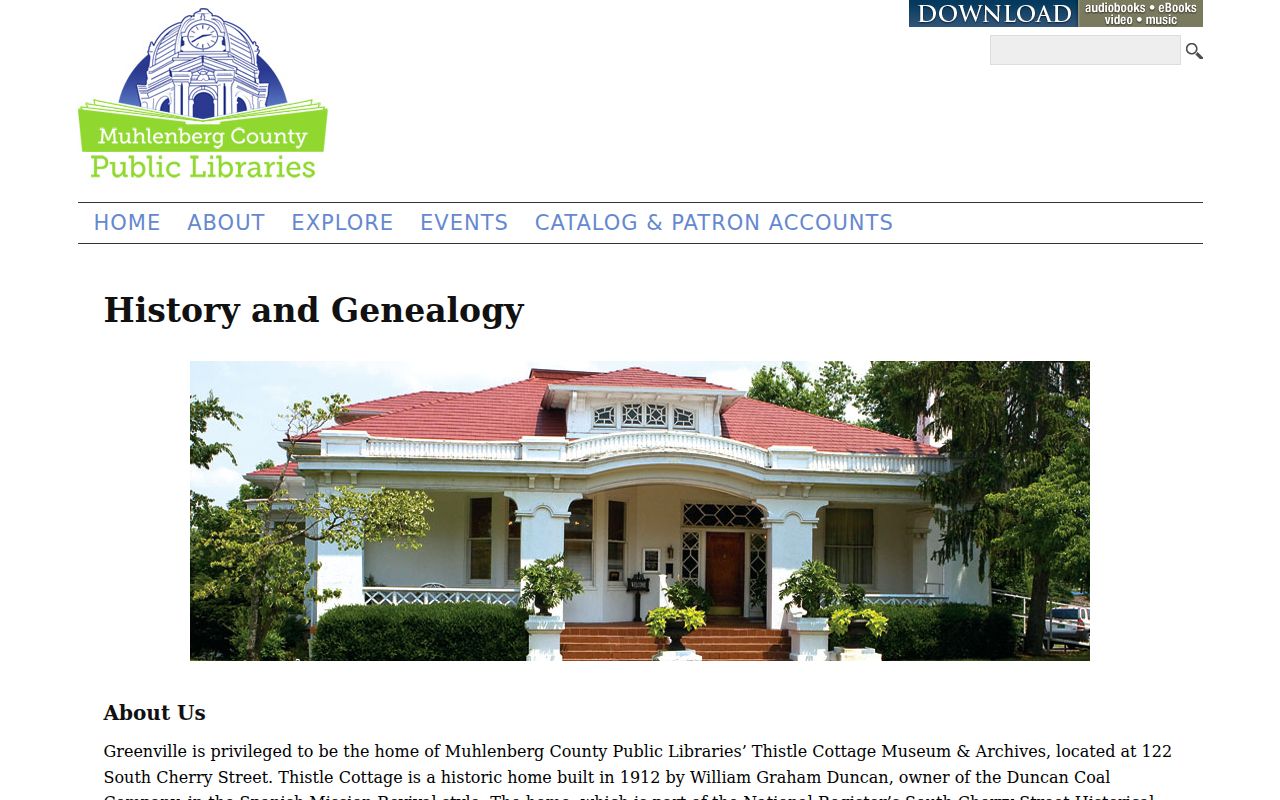
Treat the Thistle Cottage page as a finding aid, not proof. It can surface dates, names, city directories, genealogy books, newspaper leads, and obituary references. A claim about a specific South Cherry parcel still rests on the PVA card. It also rests on the recorded deed, a plat, and official district sources. Clues are starting points, and verification happens in the records themselves.
A practical house-history search starts with the present parcel card and deed. From there, work backward through former owners and local names. A Duncan Coal Company connection or a historic occupant is a clue. It is never an assumed owner of record. Library directories and obituary files may explain a name change or an occupancy period. Newspaper notices can reveal a sale, an estate, or a subdivision announcement. Before any clue joins the chain, return it to eCCLIX. Check the older deed books or the Circuit Clerk file.
Note: Preserve the citation and date for every clue you collect.
Test Greenville Property Records Against Postal Labels
Greenville's primary ZIP is 42345, with related postal routing that can include 42323. Neither number proves the land sits inside the incorporated city. County-seat documents often carry Greenville as a mailing city for rural or unincorporated parcels. A return address tells you where mail goes, not where the property lies.
Labels can disagree. Record three of them before deciding which city rules apply. These are the PVA situs, the PVA mailing address, and the USPS city and ZIP. Then compare the parcel position against Census/TIGER or GIS context. No consolidated annexation history or edge-parcel list exists. When labels conflict, request the city ordinance or map for the relevant date.
Keep Greenville Parcel IDs and Values in Context
The PVA numbering system runs countywide. Greenville carries no special prefix or map-book partition. Copy the parcel number, alternate ID, reference number, or map and account exactly. Values deserve the same caution. Kentucky's fair-cash-value standard governs PVA assessments. But assessed value is not automatically the last sale price.
The PVA sales file can list seller, buyer, city, description, deed, sale price, location, and map number for two years. Monthly updates run for one year. No official Greenville aggregate value trend or district-specific revaluation figure exists. Compare the parcel's assessment, qualified sales, deed consideration, and improvement data instead. Resist drawing a citywide claim from a single parcel.
Extend Greenville Property Records Beyond the Web
eCCLIX deed images start in April 2002, and mortgage images follow in September 2006. Older chains need other routes. Ask the County Clerk for the book or index. Then use KDLA deed microfilm, FamilySearch tax books, and Thistle Cottage or library material. Those sources help with names and context. When a current address vanishes from the old record, search fiduciaries, heirs, and adjacent owners. Old streets and company names can help too.
Insider tip. A historic article can explain a setting, but only the recorded instrument establishes the conveyance and its legal description.
CourtNet is a lead, not the full local file. Treat its case details as pointers. Carry them to the Circuit Clerk for probate, foreclosure, partition, or quiet-title records that may explain a break in the deed chain.
Read Greenville Property Records Within Their Limits
Greenville property records can show the roll owner, assessed value, recorded transfers, parcel context, current tax status, city land-use records, and court-file leads. They work best as a matched set. A city message is not a permit ledger. CourtNet is not the whole case file. The parcel polygon is not a survey, and the assessment is neither an appraisal nor a title opinion.
Lawful use. Use these records for purchase research, boundary and easement questions, tax review, estate work, local history, and civic transparency. Do not stalk, harass, or harm anyone.